Keyword Planner taught marketers to quantify what people type into search boxes. AI search requires a new framework for understanding what people ask, how those questions change with context, which prompts trigger recommendations, and how visible a brand is inside the resulting answers.
For years, the beginning of a search strategy looked like this:
That workflow became so normal that marketers learned to think about entire markets through keyword databases.
AI discovery changes the shape of the problem. A customer no longer has to compress a need into three or four words. They can describe the situation itself:
That contains location, household context, risk tolerance, product needs and a distribution preference. It is much richer than home insurance Seattle.
It also creates a harder measurement problem. What is the “search volume” of that exact sentence? How many variations represent the same underlying need? Which words change the recommendation? And if AI answers before the user ever visits a results page, how should visibility be measured?
What Keyword Planner gave marketers
Keyword research did more than generate lists. It created a common language for demand.
Keywords
The language people use to describe a need.
Search volume
An estimate of how often that need appears.
Competition
A signal of how crowded the market is.
Commercial value
Intent and CPC helped indicate business value.
Those numbers were never perfect. Their power was that they made an enormous market legible. Marketers could move from “I think people search for this” to an evidence-based plan.
AI discovery needs the same thing—but the unit of research is changing.
The unit of search is changing
| Traditional search | AI-assisted discovery |
|---|---|
| best crm | What CRM is easiest for a 10-person consulting firm that mainly uses Gmail and has no sales-ops person? |
| home insurance Seattle | Who are good home insurance agents around Seattle if I care more about claims support than the absolute lowest price? |
| shopify agency | Which Shopify agencies are good at migrating a large catalog without destroying organic traffic? |
| Seattle SEO | Recommend a smaller Seattle SEO agency that understands traditional SEO, AI visibility and WordPress. |
Calling these “long-tail keywords” misses the important part. The extra language changes the decision criteria. AI can consider company size, budget, geography, use case and preference at the same time.
The prompt family: the AI-era version of the keyword cluster
A prompt family is a group of related questions built around the same underlying need or decision.
For example, the seed topic Seattle SEO could expand into a “best agency” family, then branch through modifiers such as industry, budget, company size, local preference, AI expertise and service mix.
- What are the best SEO agencies in Seattle?
- Which Seattle SEO agency is best for a law firm?
- Recommend a smaller Seattle SEO company rather than a national agency.
- Which Seattle firms understand AI visibility as well as traditional SEO?
- Who should I hire if my SEO budget is around $4,000 a month?
The sentences are different. The customer decision is related. That is why counting exact prompts is not enough.
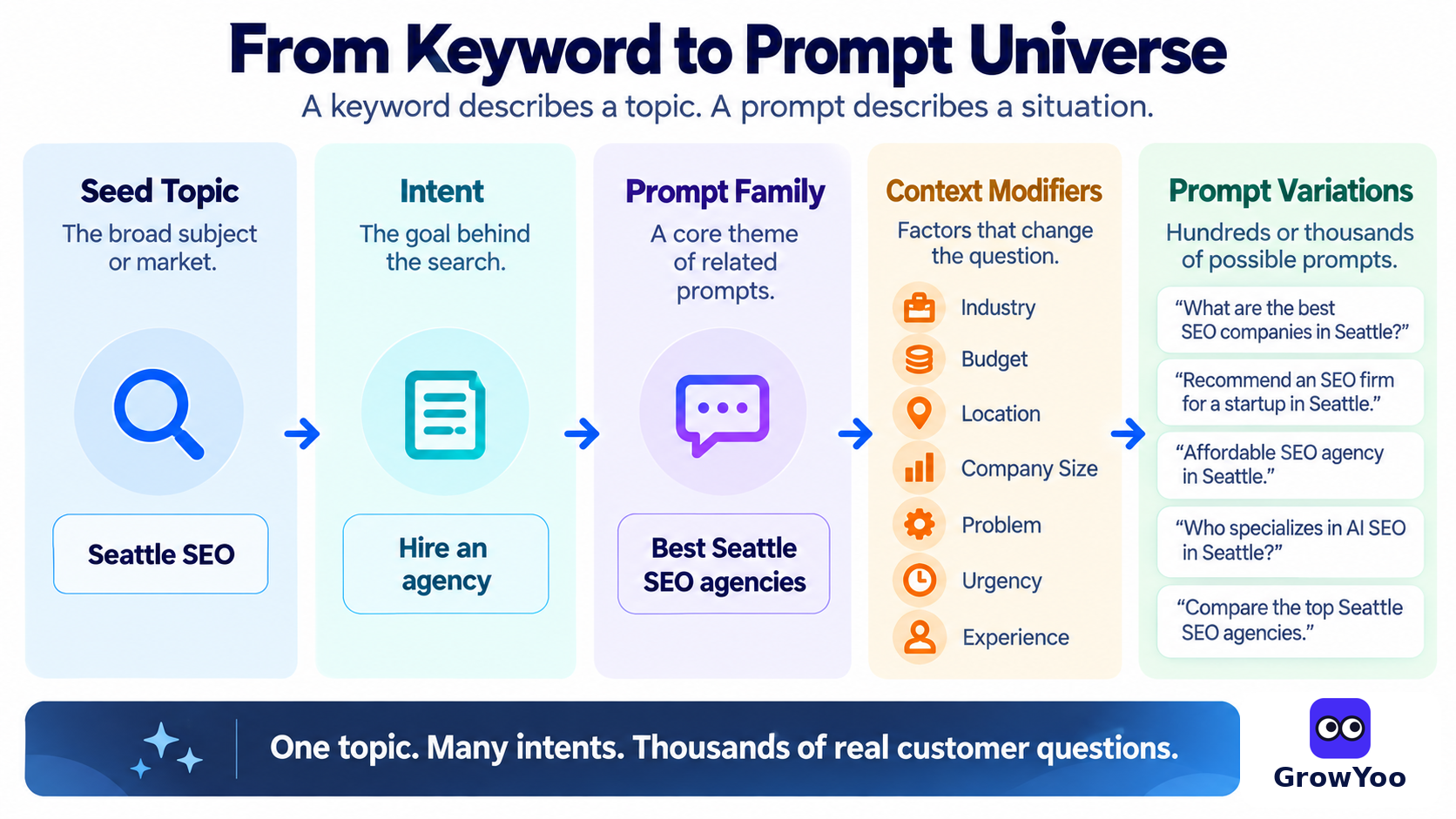
From keyword universe to prompt universe
The old workflow expanded from a seed keyword into related keywords and clusters. A prompt workflow needs another layer:
For homeowners insurance, a prompt map might include learning, comparing, estimating price, finding a local agent, bundling, switching carriers, understanding umbrella coverage and preparing for a home purchase. Add location, household, home value, claims history and budget, and the market becomes a map of needs and decisions—not merely a flat list of phrases.
The hardest problem: prompt demand
This is where the Keyword Planner analogy becomes difficult. Ten thousand people may express the same AI-assisted need in thousands of different sentences.
Ahrefs now uses an AI Adjusted Volume metric that starts with the Google search volume of a parent keyword and adjusts it using estimated usage ratios for each AI platform. Its Brand Radar documentation also explains that much of its discovery set is built from People Also Ask questions connected to its keyword index.
Semrush is attacking the problem from another direction. Its 2026 AI Visibility Index methodology says its U.S. dataset contains more than 126 million prompts, assembled from AI-search clickstream data and Google’s AI Overview keyword dataset, then deduplicated and organized while retaining intent and semantics.
Both approaches point toward the same conclusion:
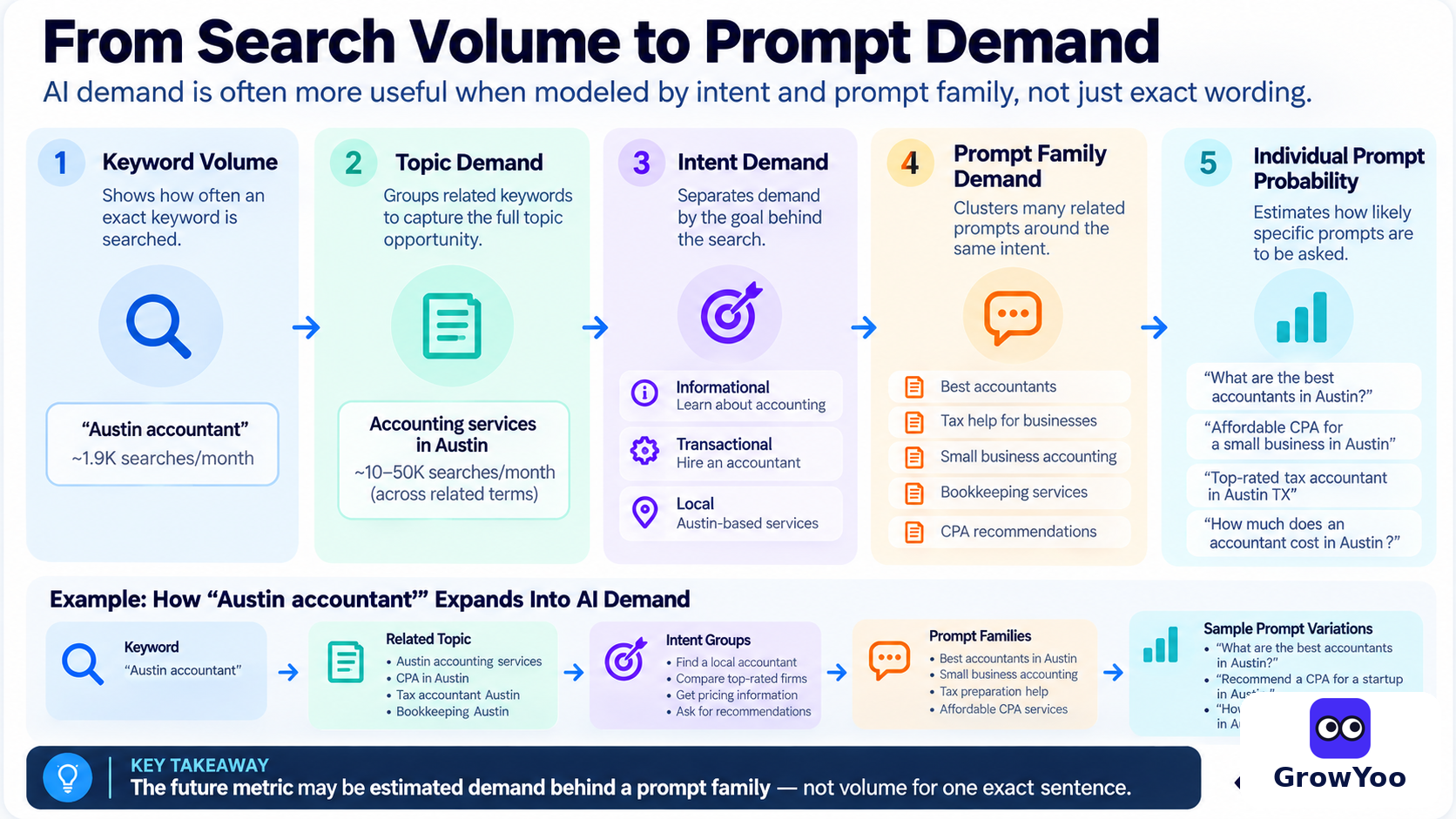
What an AI Prompt Planner should actually do
| Keyword-era capability | AI-era equivalent |
|---|---|
| Seed keyword discovery | Seed topic and market discovery |
| Keyword suggestions | Prompt-family and prompt expansion |
| Search volume | Estimated prompt demand |
| Keyword cluster | Prompt family |
| Search intent | Prompt intent + decision stage |
| Competition | Recommendation / answer competition |
| Rank | Brand presence and answer position |
| Share of search | AI Share of Voice |
| SERP analysis | AI-answer and citation analysis |
| Rank tracking | Prompt monitoring over time |
1. Discover the prompt universe
Start with a market rather than forcing the marketer to already know every prompt worth tracking.
2. Separate prompts by intent
“What is homeowners insurance?” and “Who should I call for a home insurance quote?” are not equivalent visibility opportunities.
3. Estimate demand
Even imperfect estimates are useful if they help prioritize markets and prompt families.
4. Identify context modifiers
Budget, location, industry, use case, urgency and customer characteristics can materially change the answer.
5. Detect the real competitors
The competitors that matter are the companies AI actually recommends for the same decision.
6. Measure mentions, recommendations and citations
Being cited is different from being mentioned; being mentioned is different from being recommended.
7. Track multiple engines
ChatGPT, Gemini, Google AI Mode, Perplexity and other assistants can return different brands and sources.
8. Monitor change
AI responses are dynamic. Visibility needs repeated measurement.
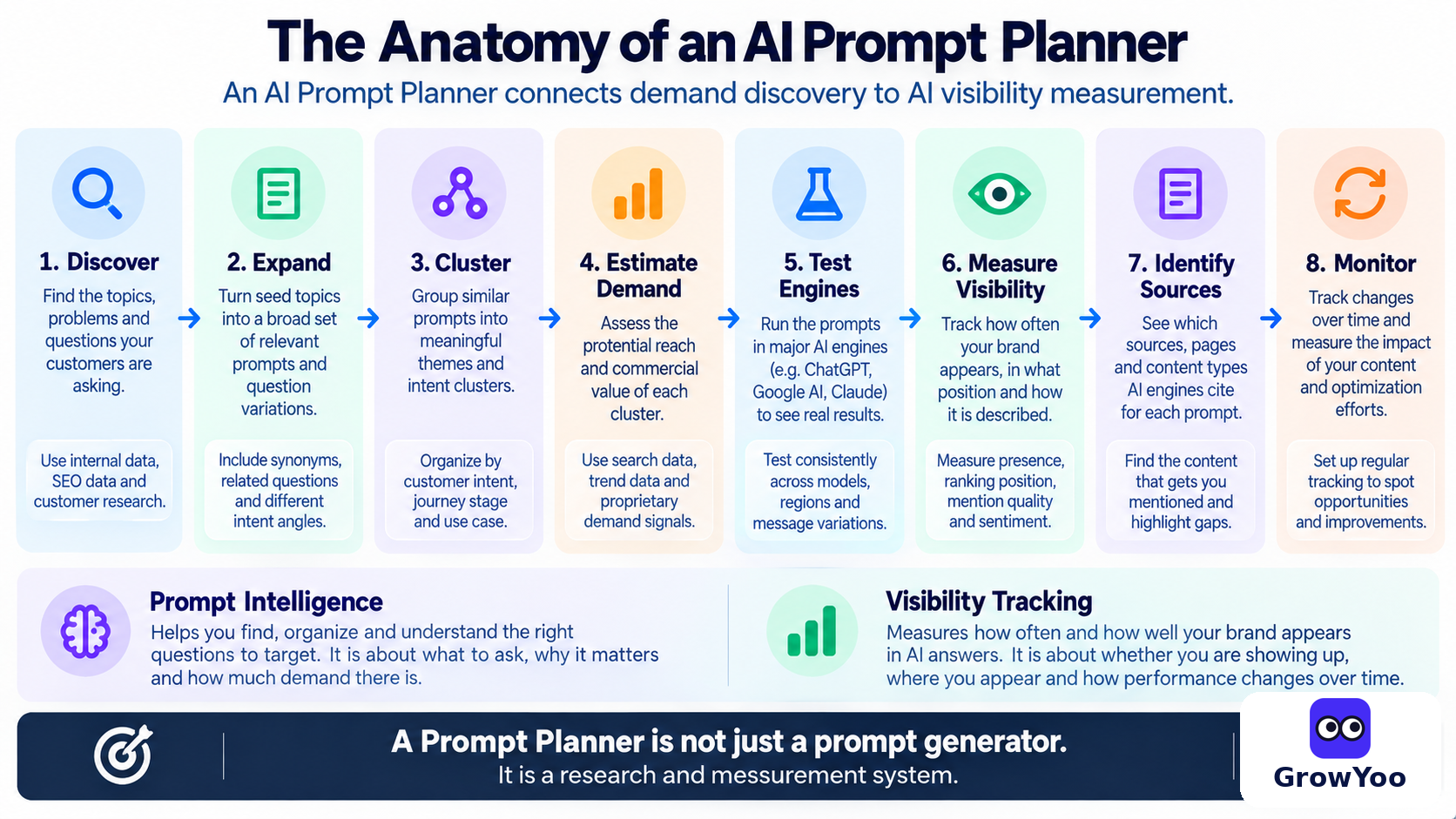
A practical prompt-research workflow you can use now
- Start with keyword data. Use Keyword Planner, Search Console, paid-search terms and existing SEO research.
- Group the market into topics. Products, services, customer problems, competitors, use cases and locations.
- Identify customer intents. Learning, evaluating, comparing, recommending, solving, buying and validating.
- Create prompt families. Best provider, X vs Y, best for use case, who should I hire, alternatives, pricing and local recommendations.
- Add context modifiers. Industry, geography, budget, size, urgency, experience and constraints.
- Prioritize commercial importance. Not every question deserves equal weight.
- Test the important set. Run it across the AI systems your customers actually use.
- Repeat. Measure frequency and change rather than trusting one screenshot.
Prompt planning and AI visibility are two halves of the same problem
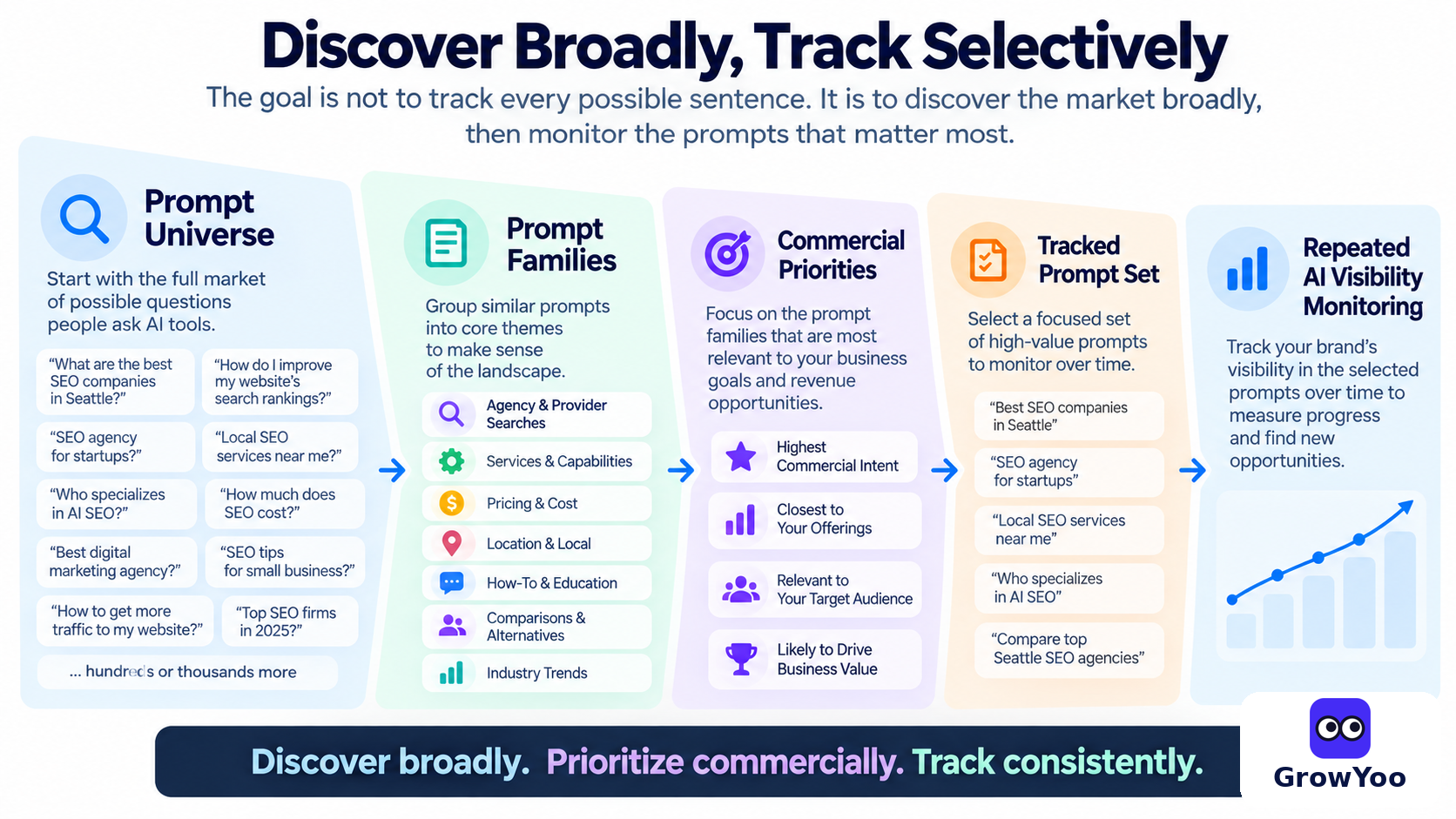
Many AI-visibility workflows begin with: “Give us the prompts you want to track.”
But that assumes the marketer already knows the important prompts. The harder question is often discovering the market in the first place.
Prompt intelligence
What questions and decisions should we be measuring?
AI visibility
What happens when those questions are asked?
Ahrefs now makes a similar distinction between broad discovery across a very large prompt index and custom prompt tracking for specific buyer questions. That is likely to become a standard model: discover broadly, track selectively.
For the measurement side of the problem, see GrowYoo’s State of AI Visibility 2026.
What a Prompt Planner still cannot know perfectly
There is no complete census of private AI conversations
Third-party tools can build sophisticated samples and datasets, but they do not simply receive every private prompt users ask every assistant.
Prompt wording can change the answer
Small contextual differences can alter which brands or sources appear.
AI responses can vary
The same prompt may produce different wording, ordering or recommendations across repeated runs.
Platforms behave differently
Semrush’s 2026 methodology explicitly reports major platforms separately because combining them can hide important differences.
Demand estimates remain estimates
Prompt demand is still an emerging metric. Directionally useful is better than pretending to have false precision.
What comes after Keyword Planner?
Probably not one single product. What comes next is a new research layer that combines the strongest parts of SEO intelligence, audience research and AI-answer measurement.
The next-generation marketer will increasingly ask:
- What topics have demand?
- What prompt families represent those topics?
- Which questions imply a real decision?
- Which AI systems are customers using?
- Which brands do those systems recommend?
- Which sources influence those recommendations?
- Where are we missing?
- What should we create or improve?
- Did visibility change?
AI search needs Prompt Planner.
And the companies that learn how to map those questions before their competitors do may gain something more valuable than another ranking report: they may understand how customers are asking machines to make decisions.
Want to see how your market looks in AI search?
GrowYoo combines traditional keyword research, prompt research, AI visibility analysis, content strategy and technical SEO to help businesses understand where discovery is moving—and where they are missing from the answer.
Get a Free Marketing AuditBook a Free Strategy CallContinue the AI Visibility series
From Search Engines to Answer Engines
How consumer search behavior is changing as AI increasingly researches and synthesizes answers.
Prompt Research Is the New Keyword Research
A hands-on methodology for finding and prioritizing the questions customers ask AI.
AI Visibility Score
How mentions, recommendations, citations, Share of Voice and prompt importance fit together.
AI Mentions vs. Citations vs. Recommendations
Why these three forms of visibility are not interchangeable.