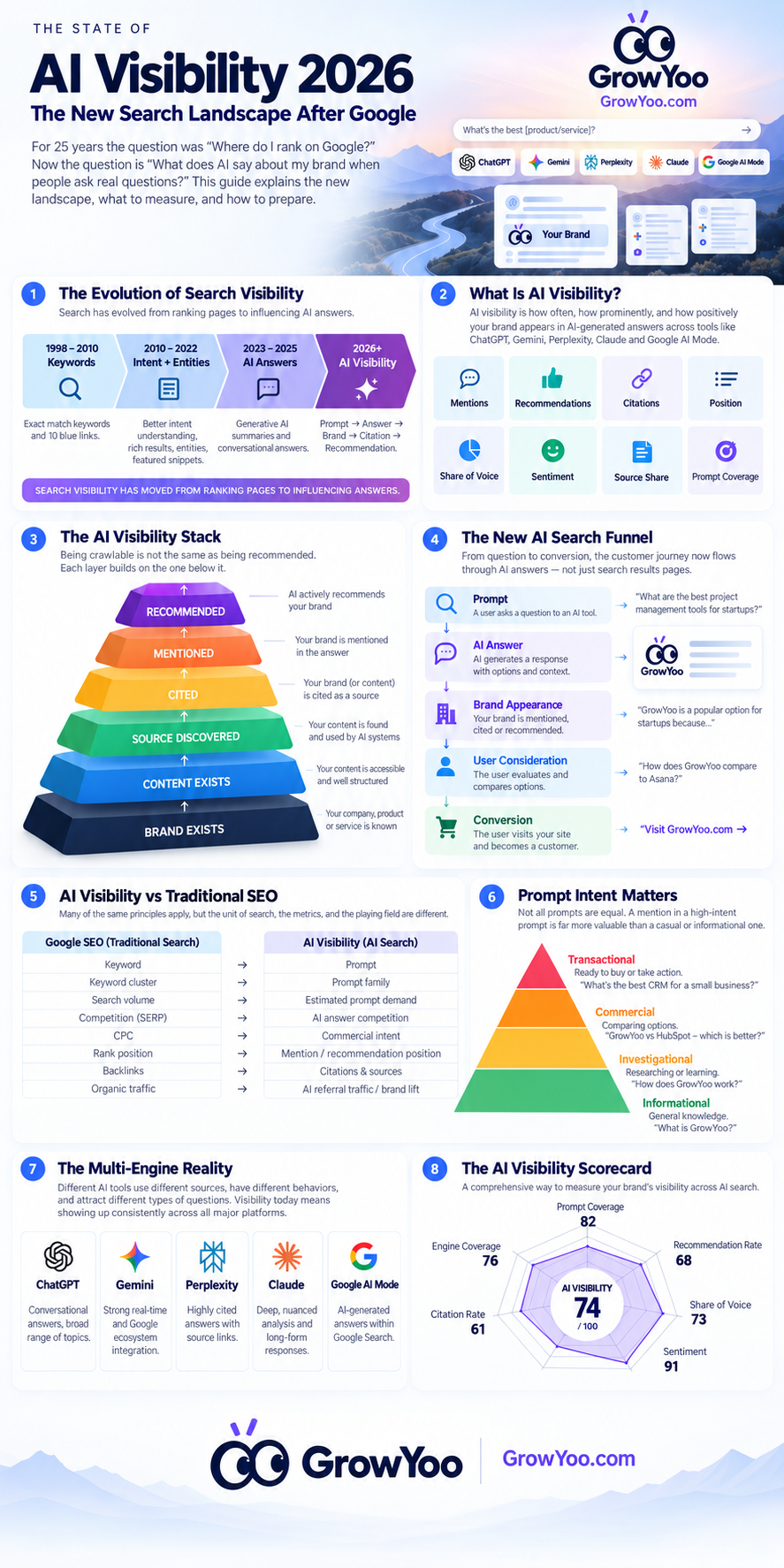
The State of AI Visibility 2026
The new search landscape after Google: a practical guide to understanding whether ChatGPT, Gemini, Google AI Mode, Perplexity and other AI systems can find, understand, cite and recommend your brand.
For more than 20 years, search marketing revolved around a familiar question:
That question still matters. But it is no longer enough.
A customer can now ask an AI assistant to compare providers, narrow options based on a budget, explain tradeoffs, research a complicated purchase, or simply recommend the company it thinks is the best fit.
Instead of returning a page of blue links, an AI system may do part of the research for the customer.
What is AI visibility?
AI visibility is the measurable presence of a brand, company, product, person or website inside AI-generated answers.
It includes more than whether your name appears. A useful AI visibility program asks whether an AI system:
Mentions you
Does the brand appear in the answer at all?
Recommends you
Does the answer actively suggest you as an option?
Cites you
Is your website or content used as a visible source?
Understands you
Does AI accurately describe what you do, where you operate and who you serve?
Positions you
Are you framed as premium, affordable, specialized, trusted, local or something else?
Compares you
Which competitors appear beside you—and who does AI prefer?
Traditional search visibility largely measured pages and positions. AI visibility measures how an entity participates in an answer.
SEO asks, “Can people find our page?” AI visibility adds, “Does the machine understand our brand well enough to include it in the answer?”
Search is becoming conversational
Google itself is moving toward a more conversational experience. In 2026, Google said AI Mode had surpassed one billion monthly active users globally, while AI Overviews had grown beyond 2.5 billion monthly users. Google also said AI Mode queries had more than doubled every quarter since launch. Source: Google
ChatGPT Search similarly lets people ask natural-language questions, continue with follow-ups and receive responses that can include links and citations to web sources. Source: OpenAI
The practical difference is easy to see.
Traditional query
Seattle SEO agency
AI prompt
I run a Seattle law firm, have about $4,000 a month to spend, and need someone who understands both Google SEO and AI search. Who should I consider?
The second search contains a location, industry, budget, need and decision criteria. It is not just a longer keyword. It is a decision context.
Prompt research is the new layer on top of keyword research
Keyword research is still useful. It tells us what people search for, how they phrase topics and where demand exists.
But AI discovery creates another layer:
- What questions do people ask AI?
- What variations of those questions matter?
- Which prompts are informational versus commercial?
- Which prompts produce brand recommendations?
- What context causes the answer to change?
- Which competitors repeatedly appear?
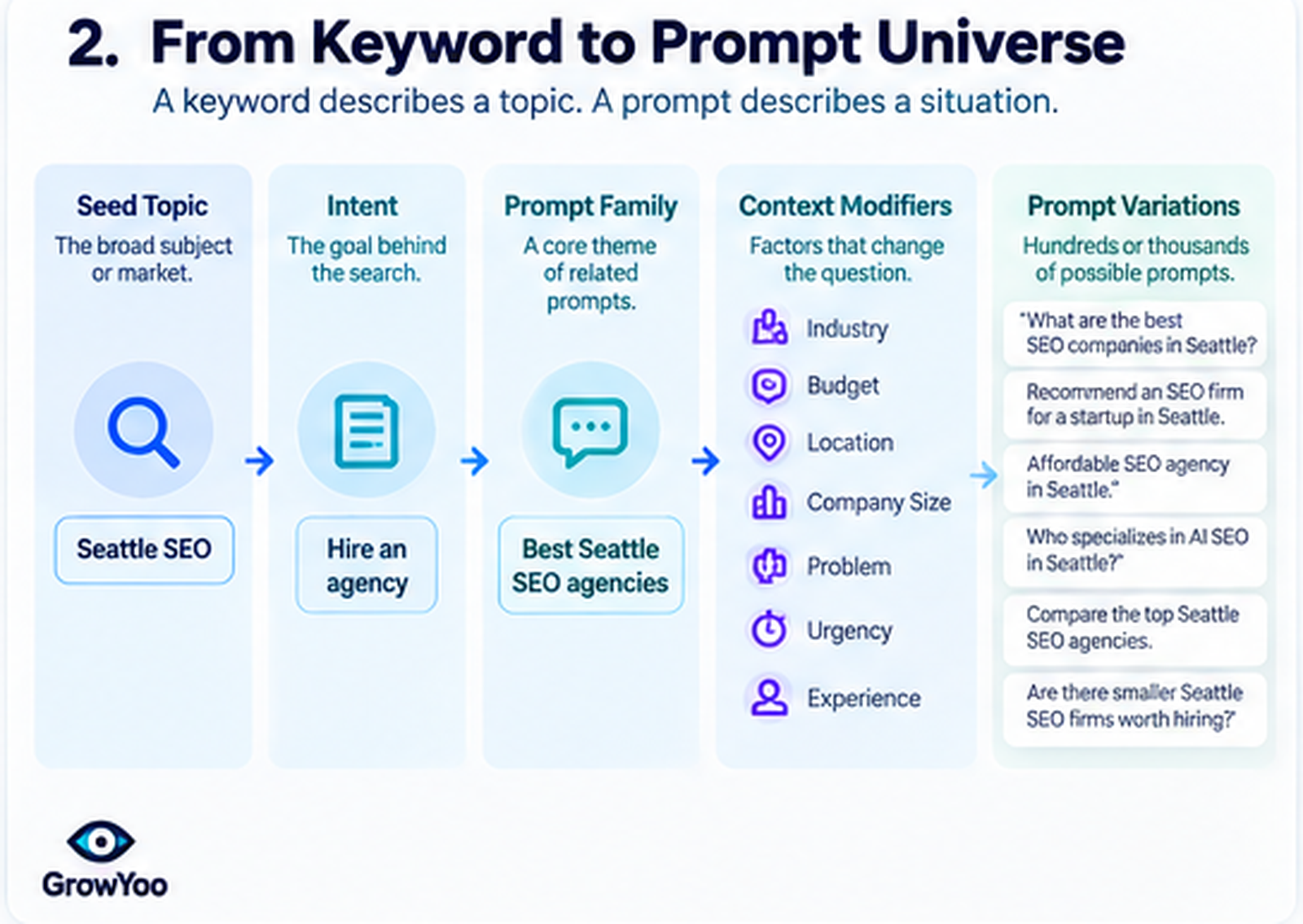
We call groups of related questions prompt families.
A prompt family starts with a topic and expands through intent and context.
The measurement problem: there is no universal Search Console for AI conversations
Google Search Console gives website owners direct data about Google impressions, clicks and queries.
AI conversations are different. Outside measurement platforms generally do not have access to every private conversation taking place inside an AI assistant.
That means AI visibility is usually measured through structured sampling: choose a meaningful set of prompts, run them across AI engines, record what appears, and repeat the process over time.
This is why the quality of the prompt set matters so much.
The market is already trying to solve this. Ahrefs, for example, says Brand Radar combines custom prompt tracking with an index of hundreds of millions of search-backed prompts. As of 2026, Ahrefs also introduced an “AI adjusted volume” approach that estimates prompt demand using parent-keyword search volume and estimated AI-platform usage. Ahrefs Brand Radar · AI adjusted volume methodology
What should you actually measure?
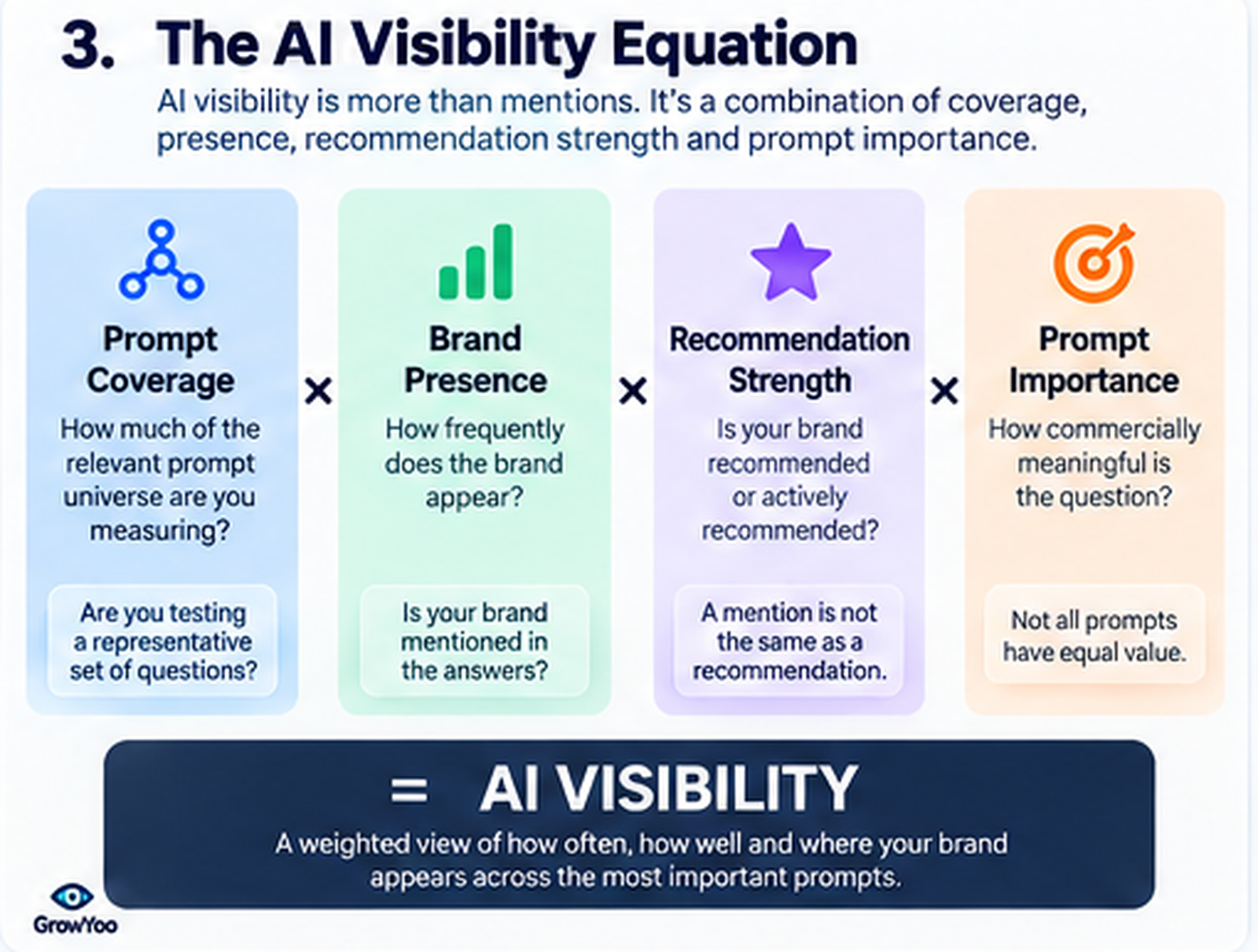
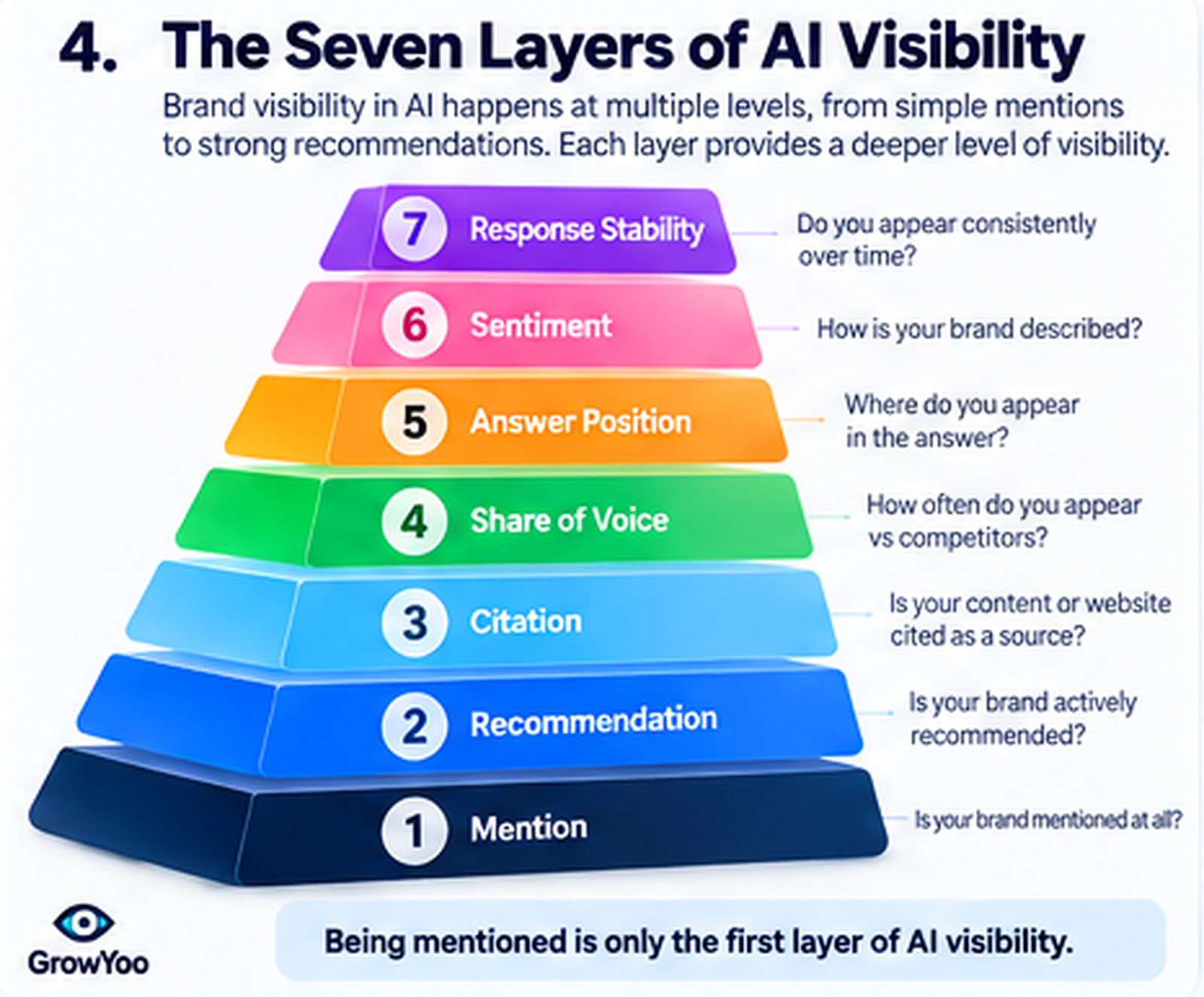
One of the easiest mistakes is reducing AI visibility to a single mention count. A useful program separates several layers.
Mentions
Does the brand appear in the response?
Recommendations
Does the AI actively suggest the brand as an option?
Citations
Is your website or content used as a visible source?
AI Share of Voice
How frequently do you appear relative to the competitors in the same prompt set?
Answer position
Where in the answer are you introduced, and how much attention do you receive?
Sentiment and positioning
How does AI characterize the brand—premium, affordable, specialized, trusted, risky, outdated?
Response stability
Do you appear consistently across repeated tests, or was the result a one-off?
Ahrefs currently reports AI visibility through metrics including mentions, citations, impressions and AI Share of Voice, which is a useful signal that the category is already moving beyond simple rank tracking. Source: Ahrefs
AI visibility should be a scorecard, not just a score
A single number can be handy for a dashboard. It should not hide the underlying story.
| Metric | What it tells you |
|---|---|
| Prompt coverage | Are we testing enough of the questions that matter? |
| Mention rate | How often does the brand appear? |
| Recommendation rate | How often are we actively suggested? |
| Citation rate | How often is our content used as a visible source? |
| AI Share of Voice | How do we compare with competitors? |
| Engine coverage | Across which AI systems do we appear? |
| Sentiment | How are we described? |
| Response stability | How consistently do we appear? |
| Commercial coverage | Are we visible for high-value decisions, not just trivia? |
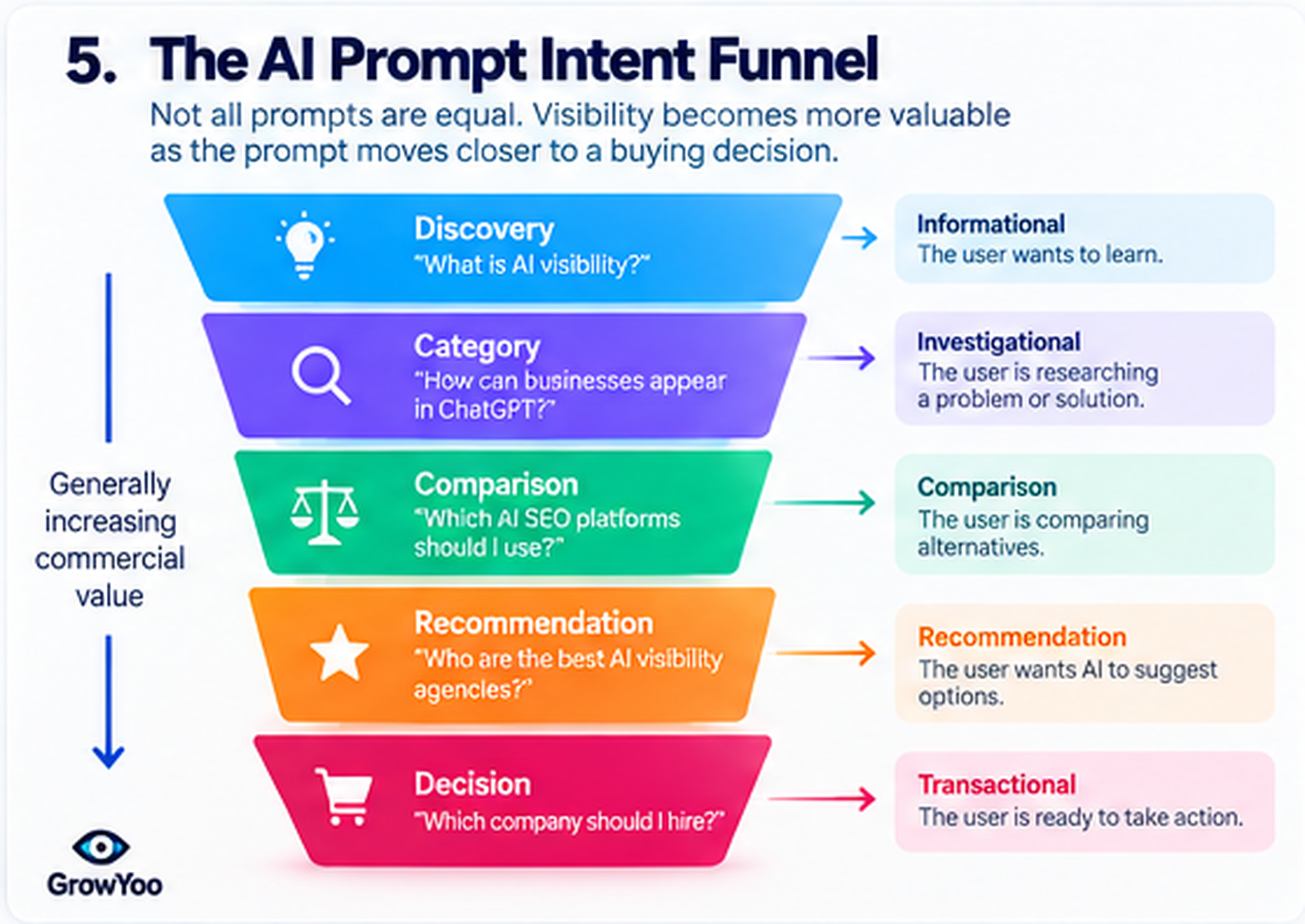
Not every prompt has equal value
Compare these two questions:
Informational
“What is GrowYoo?”
High intent
“Which agency should I hire to improve both Google rankings and AI visibility?”
A brand mention technically counts in both. Commercially, they are not the same.
This is why prompt intent should be part of measurement.
The multi-engine reality
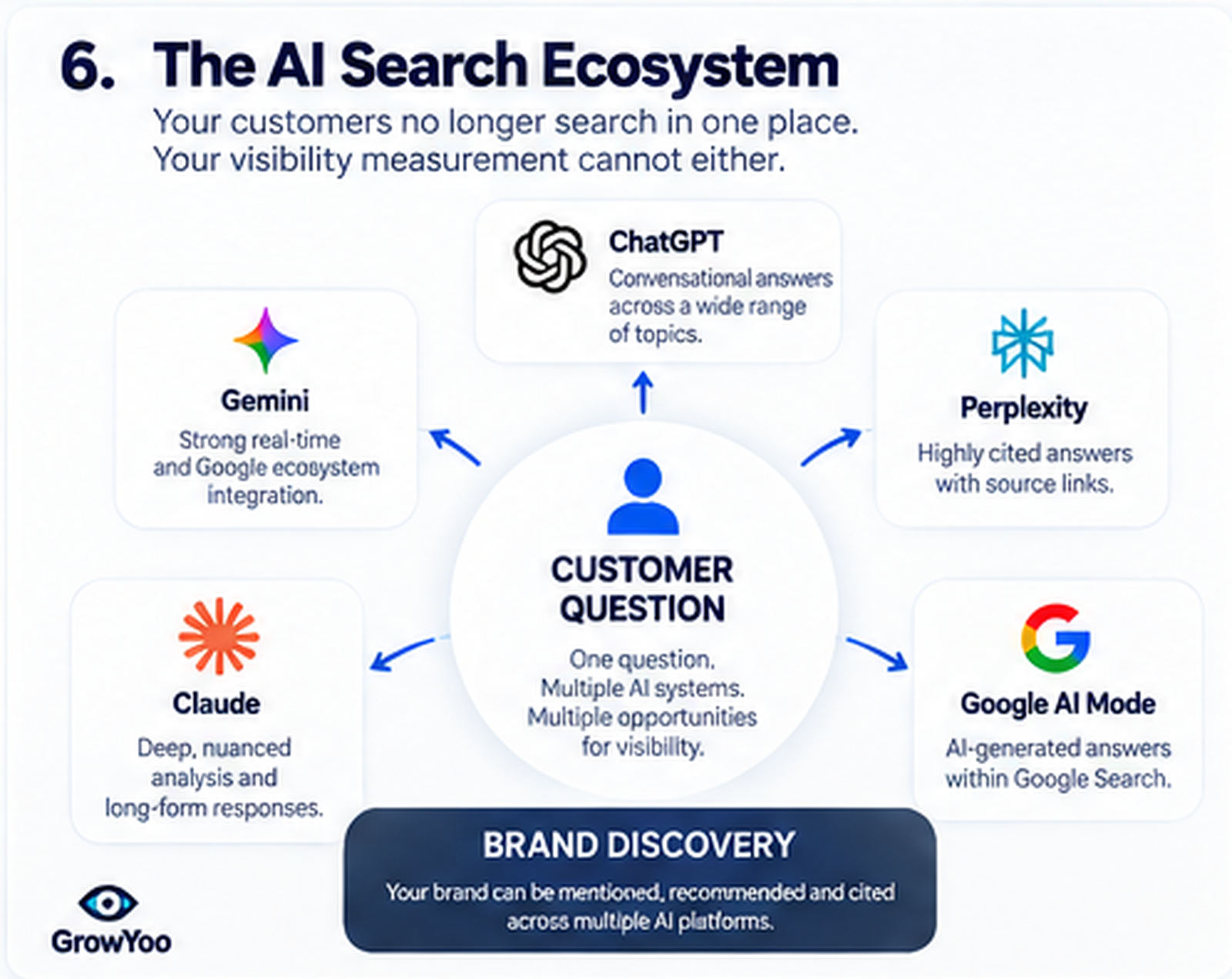
There is no single AI search engine.
Your customers may use ChatGPT, Google AI Mode, Gemini, Perplexity, Claude, Copilot or another assistant. Results can differ because platforms use different models, retrieval systems, interfaces and sources.
That means a business can be highly visible in one environment and almost invisible in another.
ChatGPT
Track brand mentions, recommendations, citations and comparison prompts.
Google AI Search
Track AI Mode and AI-generated experiences connected to the broader Google search ecosystem.
Gemini
Measure how Google’s assistant understands and describes the brand.
Perplexity
Especially useful for studying source-heavy, research-oriented responses.
The missing metric: prompt demand
One of the hardest questions in AI visibility is surprisingly simple:
Keyword tools estimate how often people search a query. AI questions are more fragmented.
These might all represent nearly the same underlying need:
- Best accountant Austin
- Who is a good CPA in Austin?
- Recommend a CPA for an Austin small business.
- I run an LLC in Austin and need help with taxes. Who should I hire?
- Which Austin accountants work with entrepreneurs?
If every prompt is treated as completely independent, demand becomes almost impossible to interpret.
A more useful model may estimate demand at several levels:
This is one reason we expect prompt research and prompt-demand estimation to become major parts of the next generation of search marketing.
Keyword Planner vs. the AI-search era
| Traditional search | AI search |
|---|---|
| Keyword | Prompt |
| Keyword cluster | Prompt family |
| Search volume | Estimated prompt demand |
| Search intent | Prompt intent |
| Ranking | Brand presence |
| SERP position | Answer position |
| Search competitor | Recommendation competitor |
| Backlink | Citation / source |
| Keyword difficulty | AI visibility difficulty |
| Search share | AI Share of Voice |
| Keyword expansion | Prompt expansion |
| Rank tracking | Prompt monitoring |
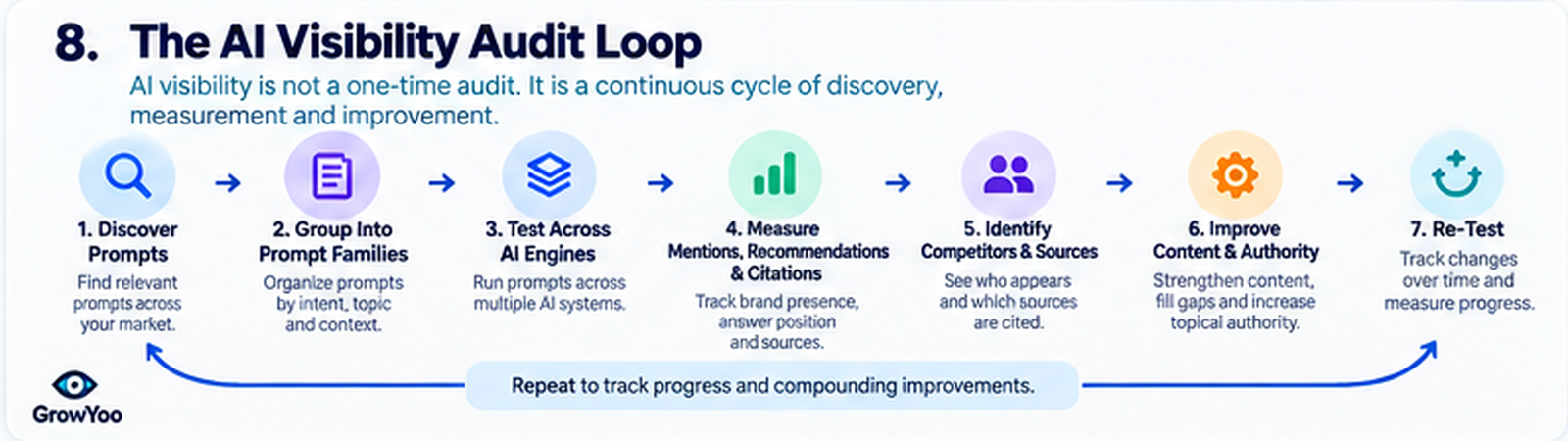
How to audit your AI visibility today
You do not need a perfect platform to begin. A disciplined manual audit is enough to learn a lot.
Identify your commercial topics
List the products, services, problems and markets you want to be known for.
Turn topics into prompt families
Create “best,” “recommend,” “compare,” “alternative,” “cost,” “local,” “problem” and industry-specific variations.
Test multiple AI engines
Start with the systems your customers are most likely to use.
Record what appears
Track your brand, competitors, citations, position, recommendation strength and sentiment.
Repeat important prompts
AI answers can vary. Measure frequency, not just one favorable screenshot.
Study the sources
Which websites, directories, publications, communities and reviews repeatedly influence the answer?
Prioritize the gaps
Focus first on high-value prompts where your visibility is weak and the path to improvement is reasonably clear.
What can actually improve AI visibility?
There is no single trick that makes every AI engine recommend a company.
A more durable goal is to make your brand unusually easy to understand, verify, trust and recommend.
Clear first-party content
Make it obvious who you are, what you do, where you work, who you serve and why you are different.
Consistent entity information
Keep names, locations, services, executives and descriptions consistent across the web.
Third-party validation
Reviews, directories, media, trade sites, podcasts and industry references can strengthen the information ecosystem around a brand.
Original information
Research, benchmarks, experiments, case studies and proprietary data give other people—and machines—a reason to cite you.
Strong SEO fundamentals
Accessible, authoritative and well-structured web content still matters when AI systems retrieve information from the web.
Continuous measurement
Models, retrieval systems, competitors and source material change. Re-testing is part of the process.
SEO, GEO, AEO, LLMO… what should we call this?
The industry has produced a lot of overlapping acronyms:
We use AI visibility as the umbrella measurement concept because optimization should come after you understand what is happening.
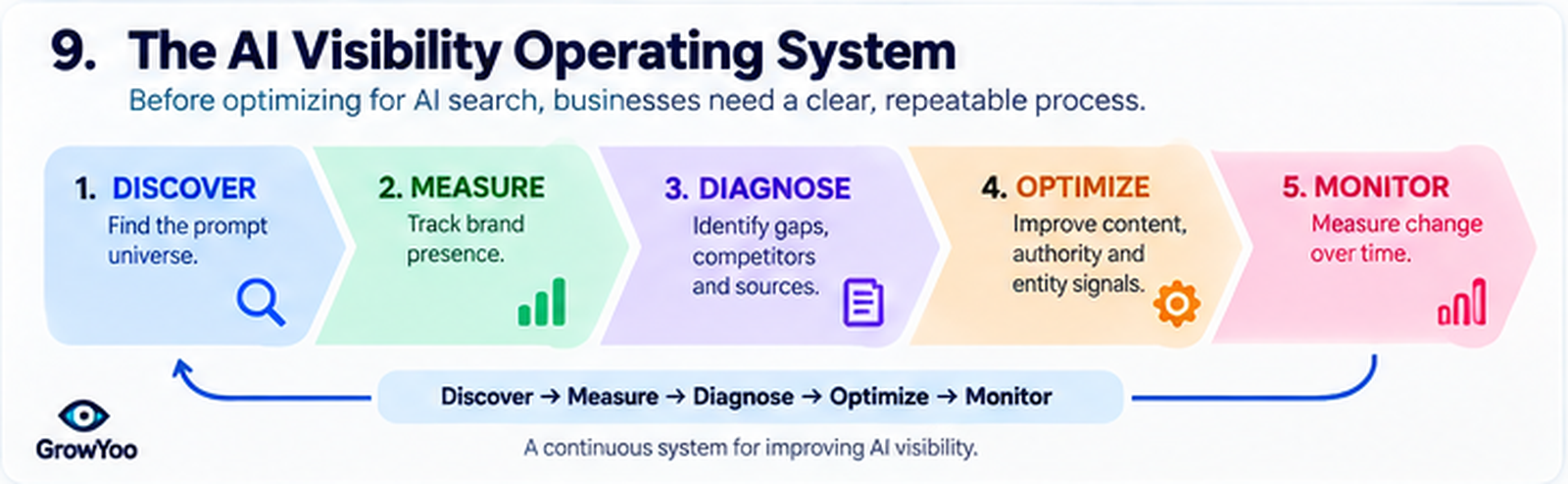
What comes next?
The category is still being built in real time, but several directions are already visible.
Prompt databases will become normal
Search marketers expect keyword databases. AI marketers will increasingly expect databases of representative prompts and prompt families.
Prompt demand will become a core metric
The industry will continue developing methods to estimate how much demand sits behind a prompt or family of prompts.
AI Share of Voice will become more important
Brands will care not only about whether they appear, but how consistently they appear relative to the competitors customers are considering.
Citation intelligence will become its own discipline
Marketers will want to know which domains, pages and communities repeatedly influence AI answers.
Prompt tracking will resemble rank tracking—but it will not be the same
Instead of one position, useful reports may track mention probability, recommendation probability, citations, answer placement, sentiment and stability.
AI and traditional search data will converge
The most useful systems will connect keyword demand, prompt demand, search rankings, AI visibility, citations, traffic and conversions rather than treating them as separate worlds.
Semrush’s 2026 AI Visibility Index study, based on 126 million real-user prompts, is another sign that AI visibility has already become a serious measurement category rather than a niche experiment. Source: Semrush
The new search-marketing question
The old question was:
The new questions are broader:
What are customers asking?
Which prompts and prompt families represent the market?
Are we part of the answer?
Are we mentioned, cited or recommended?
Who appears instead?
Which competitors dominate important decisions?
Why?
Which sources, signals and information gaps are shaping those answers?
The tools will change. The models will change. The terminology will probably change too.
But the business objective is simple:
Want to know how visible your business is?
GrowYoo looks at traditional search visibility, AI prompts, competitor visibility, citations, website authority and the gaps that may be keeping your company out of the answer.
Continue the AI Visibility series
The AI Prompt Planner
What comes after Google Keyword Planner—and why prompt research may become the next layer of keyword research.
AI Prompt Volume
Can we estimate how often people ask AI a question?
Keyword Volume vs. Prompt Volume
Why search demand and conversational demand are related, but not identical.
AI Visibility Score
How mentions, recommendations, citations and Share of Voice can fit into one measurement framework.
Frequently asked questions
What is AI visibility?
AI visibility describes how often and how prominently a business, brand, product or website appears in AI-generated answers across platforms such as ChatGPT, Gemini, Google AI Mode and Perplexity.
How do you measure AI visibility?
Useful measurements include prompt coverage, brand mentions, recommendation frequency, citations, AI Share of Voice, answer position, sentiment, engine coverage and response stability.
Can you rank in ChatGPT?
Not in the same way a webpage ranks in a traditional Google results page. A more useful approach is to measure how frequently and prominently a brand appears across a representative set of prompts and repeated answers.
What is AI Share of Voice?
AI Share of Voice compares how frequently your brand appears across a defined prompt set relative to competing brands.
What is prompt research?
Prompt research is the process of discovering, organizing and prioritizing the questions people are likely to ask AI systems about a topic, company, product, service or problem.
Does SEO help AI visibility?
It can. AI systems often use information retrieved from the web, so technically accessible, relevant and authoritative content remains important. AI visibility also depends on broader signals such as citations, third-party references, brand authority and entity consistency.